Work Comparison
Kestrel vs. Sprout AI: Which Job Application Tool Fits Your Search?
Sprout and Kestrel both take repetitive work out of applying for jobs. They differ in who presses Submit, what their plans actually meter, and what else they help you plan.
Kestrel publishes this comparison and has a commercial interest in it. Sprout is described from its website, pricing page, MCP page, Help Center, and App Store listing, checked November 11, 2026, not from a paid account. Features and prices change; we re-check every 90 days.

The short answer
- Choose Sprout if you want to automate a higher volume of applications, prefer a mobile app, and are comfortable letting an AI agent submit for you, with an optional Manual Review queue when you want to check first.
- Choose Kestrel if you want remote jobs ranked against where you can work, a tailored resume, cover letter, and interview prep for each role, application tracking, and a chance to review the filled employer form before you press Submit yourself.
- On price, Kestrel Core is $29 a month and Sprout's Monthly plan is $39.99. Kestrel meters tailored packets and Sprout meters application credits, so the two allowances don't compare one for one.
- Both connect to AI assistants, including ChatGPT and Claude.
Applying for remote jobs can turn into a routine of dozens of open tabs, the same resume updated again, another application form, and the nagging question of whether the employer can even hire someone where you live.
AI job application tools promise to make that easier. Sprout and Kestrel both help people find openings, prepare application materials, and spend less time on repetitive work.
Where they part ways is the submission itself.
Sprout leans into automated applications. It can prepare and submit applications for you, and it offers an optional review queue for anyone who wants to check first.
Kestrel concentrates on remote-job fit, tailored documents, and application tracking. Its browser extension fills supported employer forms and attaches your documents, then leaves the final Submit to you.
That difference matters more than it might seem, because job sites and employers set their own rules about automated applications.
Pricing works differently too. Sprout sells application credits. Kestrel's plans include tailored application packets, and a packet's documents can often be reused when you apply to similar roles.
Here's what each platform offers, where each is strongest, and how to decide which approach fits your search.
Kestrel vs. Sprout AI at a glance
| Area | Kestrel | Sprout AI |
|---|---|---|
| Primary focus | Remote work, application preparation, and mobility planning | Job discovery and automated applications |
| Application documents | Tailored resume, cover letter, and interview prep | AI-tailored resume and cover letter |
| Employer forms | Fills supported forms and attaches your documents | Completes applications and can submit them |
| Final submission | You press Submit | Automated, or held in a Manual Review queue when turned on |
| Usage allowance | Tailored application packets | Application credits |
| Application tracking | Yes | Yes |
| AI assistant connections | Claude, ChatGPT, Claude Code, Codex, Cursor, and others | Claude, ChatGPT, and Gemini |
| Education and relocation | Built-in planning tools | Not advertised as core features |
| Platforms | Web, including phone browsers; Kestrel Apply for desktop Chrome | iOS app, web, and Chrome extension |
| Starting price | Free plan; Core at $29 a month | Weekly at $19.99; Monthly at $39.99 |
Features as described on each company's public pages, checked November 11, 2026.
Sprout AI: Automation and application volume
Sprout is built to make applying at scale easier.
It searches more than 10 million jobs from company career sites, job boards, and partner networks, with filters for industry, location, and remote, hybrid, or on-site work. You swipe right on a role you like, and Sprout prepares a tailored resume and cover letter and works through the employer's application for you. A tracking dashboard shows every application and what's next.
Sprout also offers a Manual Review queue. With it turned on, every job you swipe right on waits in the queue, and nothing goes out until you approve the documents and answers. That's useful for anyone who wants the automation without giving up review entirely.
Sprout runs as an iOS app, on the web, and as a Chrome extension that fills job applications. Its MCP connector lets you search and apply from Claude, ChatGPT, or Gemini, and Sprout says nothing is sent from the chat until you approve it.
Its main appeal is convenience and throughput. If you want to send a high volume of applications, especially from your phone, Sprout makes a strong case.
Kestrel: Tailored applications with the candidate in control
Kestrel starts somewhere else: with roles that actually fit your experience, your working hours, and the countries you can work from.
Kestrel Work ranks more than 10,000 live remote roles against where you can work and the direction you want your career to go. That matters because a job advertised as remote may still require you to live in a particular country or keep particular hours.
When you find a role you want, Kestrel prepares an application packet from the career facts you've approved: a tailored resume, a cover letter, and interview prep for that posting. If the posting asks for something your record doesn't cover, Kestrel asks you rather than inventing it.
Kestrel Apply, Kestrel's Chrome extension, then takes on much of the repetitive form work. On Workday, Greenhouse, Lever, Ashby, Workable, and many other hiring systems, it fills the fields it can, attaches the packet's resume and cover letter, and lists every field it left for you.
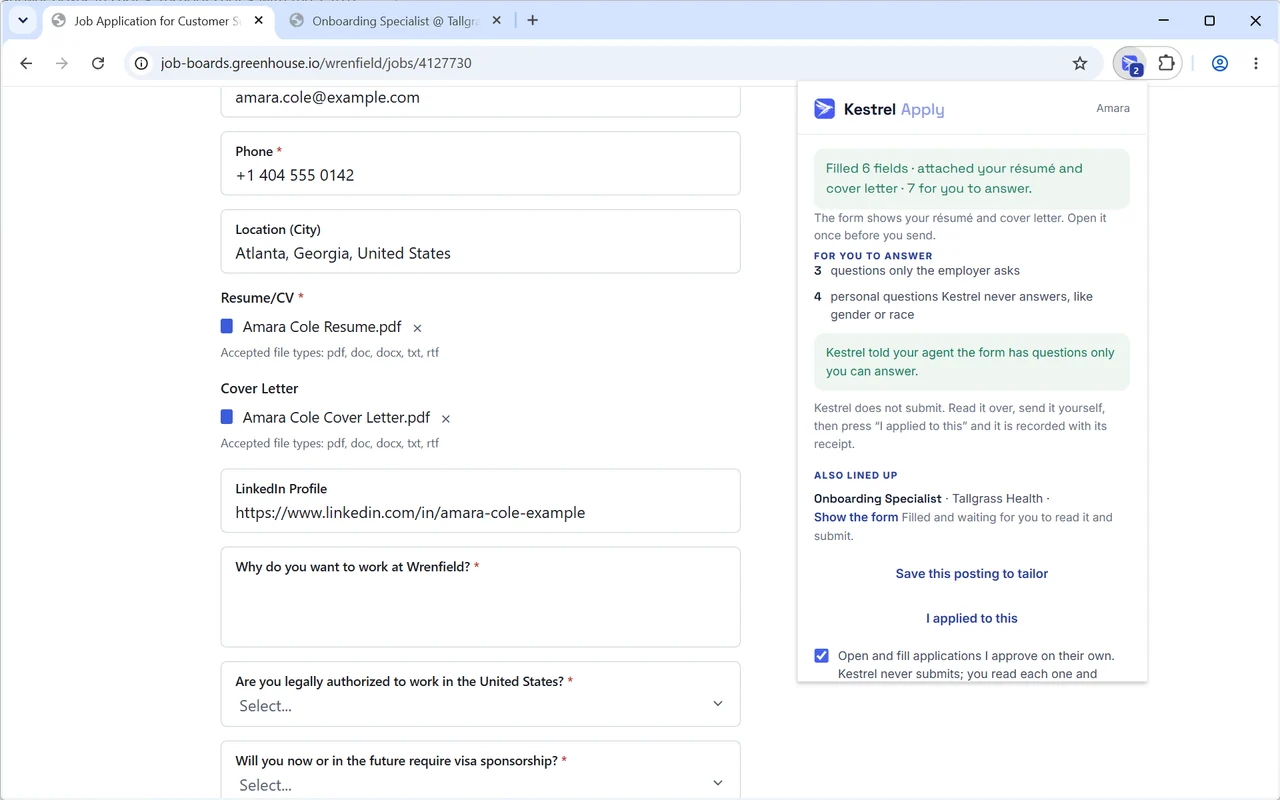
You review the result, answer anything that needs your judgment, and press the employer's own Apply or Submit button.
None of this requires an AI assistant. You can open a form and press Fill yourself, or connect Kestrel Agent to Claude, ChatGPT, or another supported assistant and have it line applications up for your approval.
After you apply, Kestrel's tracker keeps each role's stage, from saved and applied through interview, offer, or a closed role, along with the next step to take.
Kestrel also ties the job search to online study and relocation planning, which can matter if your plans include a new qualification or working from another country.
Auto-apply versus assisted applications: why the difference matters
Applying for jobs has always involved repetitive work. AI can now handle a lot of it, from organizing your career history to drafting documents and completing forms.
There is still a difference between helping someone apply and submitting applications without their direct involvement.
Some hiring platforms restrict unauthorized automation. Indeed's terms prohibit using automation, scripts, or bots to automate the Indeed Apply process outside Indeed's official vendors and tooling. LinkedIn doesn't allow third-party software or browser extensions that automate activity on its website, and its User Agreement bars bots and other unauthorized automated methods.
Individual employers can set their own application instructions, too.
That doesn't mean every kind of AI help is off limits. Writing help, document preparation, form filling, and automated submission can each be treated differently depending on the site and the employer.
It also doesn't mean an application is compliant just because a person clicked the final button. Candidates still need to follow the instructions and rules of the employer and the site they're applying through.
Where Kestrel fits
Kestrel's workflow is built around a final human review. It can prepare documents, attach files, and fill supported fields, but before anything is sent, you see what was entered and complete the submission yourself.
That gives you a chance to catch mistakes, answer questions that call for judgment, and confirm the materials reflect your real experience. It also keeps a clear decision point before your information goes to an employer.
The benefit is control over what you send, alongside the time saved preparing it.
Application credits versus application packets: what are you actually paying for?
At first glance, Sprout's advertised application allowance looks much larger than Kestrel's packet allowance. The two numbers describe different things.
Sprout uses credits. A credit is deducted when you swipe right to apply. A standard application uses one credit, and a role that is more complex or needs more context uses three. Sprout refunds the credit automatically if an application fails because of a system issue. How many applications a plan really covers depends on how many credits each job takes.
Kestrel's allowance works differently. A packet is a set of tailored documents prepared for one job: a resume, a cover letter, and interview prep. The allowance covers that preparation work. It is not a count of how many applications you can submit.
| Question | Kestrel | Sprout |
|---|---|---|
| What is metered? | Preparing a tailored application packet | Credits, used when you swipe right to apply |
| What does one unit cover? | A resume, cover letter, and interview prep for one role | One application: 1 credit for a standard role, 3 for a complex one |
| Does the allowance equal applications submitted? | No | No, because credit costs vary by role |
| Can documents be reused? | Yes, by downloading, editing, and uploading them where they fit | Not confirmed in public documentation |
Do you need a new resume for every job?
Not necessarily.
Say you're applying to 10 operations manager roles at different companies. If they ask for much the same experience in operations, project coordination, vendor management, reporting, and team leadership, one carefully prepared resume may suit several of them.
You should still read each posting and adjust where it matters. A cover letter may need a new company name, a different opening, or a deeper rewrite to match what that employer cares about.
In Kestrel, you can download a packet's documents as PDF or Word, edit them, and upload them to another application where they still fit. Kestrel Apply attaches the packet prepared for the role you're applying to, so reusing documents for a different job is a step you take yourself.
The point is simple: a tailored packet is a document-preparation allowance, not a cap on how many applications you can send.
Kestrel vs. Sprout AI pricing
Full paid plan, list price
Core
$29
a month, or $290 a year
Free plan and a 72-hour trial
10 tailored application packets a month. Founder $19 with 15 while places last; Pro $39 with 40.
 Monthly
$39.99
a month, advertised as 200 applications
No free plan found; the app is free to download
Weekly $19.99 for 50. Quarterly $79.99 for 600. A standard application uses 1 credit, a complex one 3.
Kestrel has a free plan and three paid memberships. Core costs $29 a month, or $290 a year, and includes 10 tailored application packets a month. Pro costs $39 a month and includes 40. Founder costs $19 a month with 15 packets, for the first 300 paid members while places remain. A 72-hour free trial lets you try the full workspace first.
Sprout advertises three plans: Weekly at $19.99 for 50 applications, Monthly at $39.99 for 200, and Quarterly at $79.99 for 600. We didn't find a free plan, though the app itself is free to download. Its Help Center explains that credit use varies with how complex an application is.
Month to month, Kestrel Core costs $10.99 less than Sprout Monthly. Over longer terms, Kestrel's annual Core plan works out to about $24.17 a month, Sprout's Quarterly plan to about $26.66 a month, and Sprout's Weekly plan to about $86.62 over an average month.
That gap is useful context, but it isn't a comparison of application volume. Sprout sells a workflow built around automated applications. Kestrel's paid plans include document preparation, form filling, tracking, remote-job research, and education and relocation planning.
The better value depends on which of those you'll actually use. Prices checked November 11, 2026.
Which should you choose?
Choose Sprout if you prioritize application volume
Sprout makes sense if you want to cut manual application work as far as possible. Its mobile app, automated submission, and optional Manual Review queue give you different ways to run the process.
If your priority is applying to many roles with little repetitive effort, Sprout is worth a look.
Choose Kestrel if you want more control over each application
Kestrel makes sense if you want help finding remote roles you can actually take, preparing accurate documents, completing supported employer forms, and keeping track of where every application stands.
The final submission stays with you.
Kestrel may also suit you better if your plans include a new qualification, a new city, or working across borders.
The bottom line
Both products take repetitive work out of a job search.
Sprout automates more of the submission. Kestrel pairs application help with a human submission step and a wider set of career and mobility planning tools.
Choose based on the work you want automated, the control you want to keep, and the rules of the sites where you're applying.
How we compared them
Kestrel published this comparison and has a commercial interest in its subject.
Kestrel's features were checked against the current product and membership configuration. Sprout's features, pricing, credits, and review controls were taken from its public website, pricing page, MCP page, Help Center, and App Store listing. We did not test Sprout with a paid account.
Platform automation policies were checked against Indeed's and LinkedIn's own published terms and help pages.
Features and prices reflect what was available on November 11, 2026, and may change. Neither platform guarantees an interview, a job offer, or that an application will be accepted.
Questions people ask
Is Kestrel a good alternative to Sprout AI?
Kestrel is an alternative for people who want remote roles matched to where they can work, tailored application documents, form filling, and application tracking while keeping control of the final submission. It also includes education and relocation planning.
Does Kestrel automatically submit job applications?
No. Kestrel Apply fills supported employer forms and attaches your approved documents, but you review the application and press Submit yourself.
Does Sprout let users review applications before they're sent?
Yes. Sprout offers an optional Manual Review queue. With it turned on, jobs you swipe right on wait until you approve the documents and answers.
Can employers or job sites reject automated job applications?
Some job platforms restrict unauthorized automated applications, and rules vary by site and employer. Review the application instructions and the site's terms before using any third-party tool.
What is the difference between Sprout credits and Kestrel packets?
Sprout credits are used when you start an application, 1 for a standard role and 3 for a complex one. A Kestrel packet is a tailored resume, cover letter, and interview prep for one role. The two allowances aren't directly comparable.
Can I reuse a Kestrel resume for more than one job?
Yes, when it stays accurate and relevant. You can download a packet's documents as PDF or Word, edit them, and upload them to similar applications. Check each posting's requirements and update employer-specific details.
Is Kestrel cheaper than Sprout AI?
On standard monthly pricing, Kestrel Core is $29 and Sprout Monthly is $39.99 as of November 11, 2026. Their allowances and features differ, so compare the services you need rather than price alone.
Do both platforms work with ChatGPT and Claude?
Yes. Sprout's connector works with Claude, ChatGPT, and Gemini. Kestrel Agent works with Claude, ChatGPT, Claude Code, Codex, Cursor, and other assistants that support connectors, and Kestrel Apply also works on its own without any assistant connected.
Sources and method
- Sprout, Sprout home page. Checked .
- Sprout, Pricing. Checked .
- Sprout Help Center, How credits work. Checked .
- Sprout Help Center, Removing a job from your review queue before it's submitted. Checked .
- Sprout, Sprout MCP. Checked .
- Apple App Store, Sprout - AI Job Search. Checked .
- Indeed, Terms of Service. Checked .
- LinkedIn Help, Automated activity on LinkedIn. Checked .
- LinkedIn, User Agreement. Checked .
- Kestrel, Pricing. Checked .
Written by Kestrel Research. Kestrel product details come from Kestrel's own product and pricing pages. Policies, prices, and eligibility change; confirm final requirements with the responsible institution, employer, or government agency.